Possession (1981)
Extreme psycho-trauma for would be divorcees, cold war style

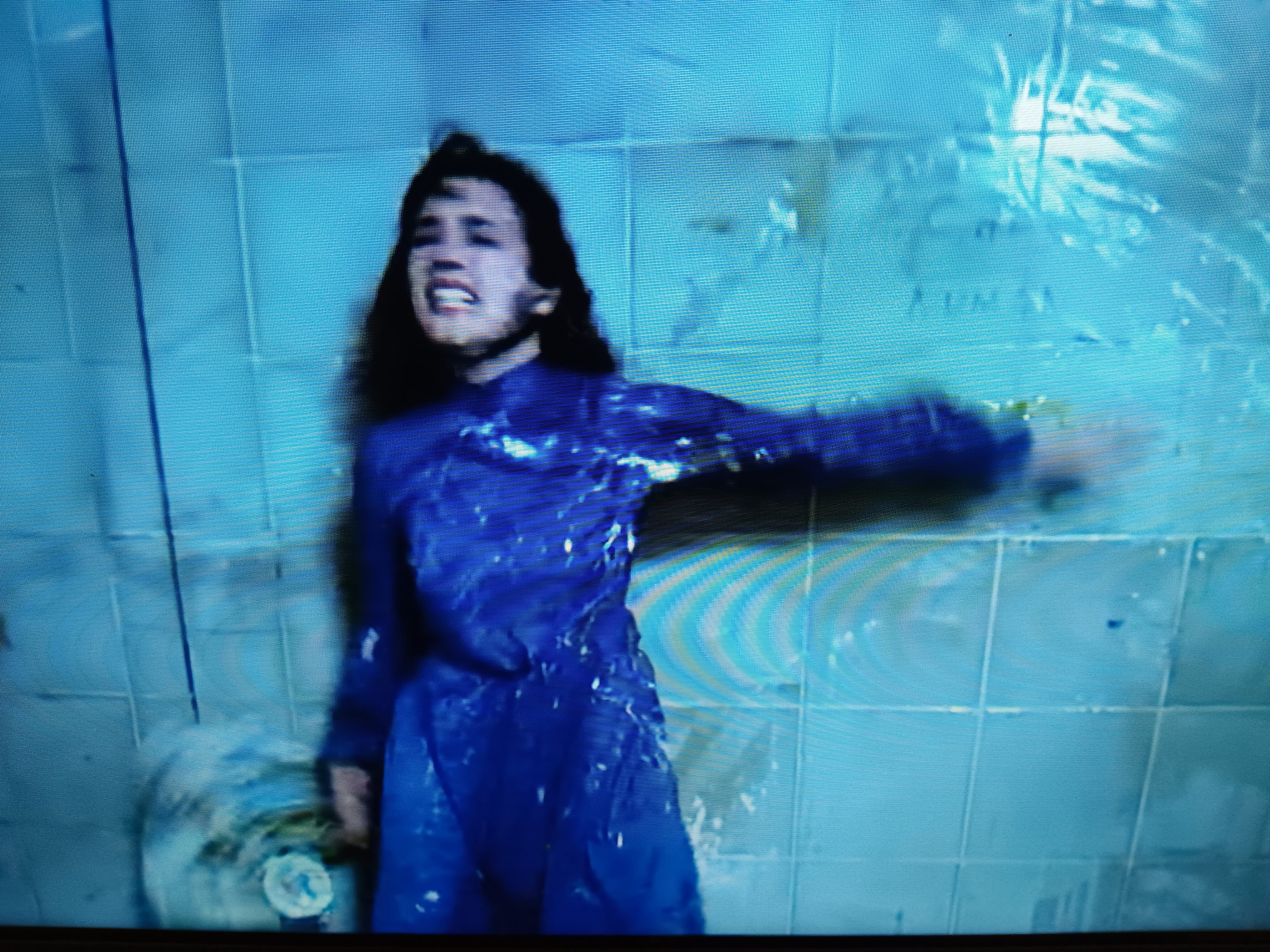
Who amongst us (who've at some point in our lives been in significant relationships with significant others long enough to have experienced rows that seemed to evolve way beyond the airing of grievances into something almost operatic, arguments whose moorings in logical protest over behavioural differences have become unloosed and twisted into something primeval and almost pre-human), can honestly say that those same hysterical shrieking matches haven't at one time or another resulted in the police being called by concerned neighbours or interested passers by? Precious few of us, I imagine. Possession (1981), which I saw last night for possibly the first time ever, is the kind of film I almost certainly would have seen, if not on release, then at some point in the 40 odd years following that date, it being the sort of uncategorizable, art-house psychodrama that people like me (and what, pray, would those sorts be? Well, there's a question which can never be satisfactorily answered, least of all by me!) are drawn to like bees to honey pots or cats to high grade, quasi-hallucinogenic catnip.
And yet, I have no memory of having seen it previously. Memory, though, as you'll know if you make a habit of reading these pieces, and as I've had recent cause to remark, as a regular experiencer of the little known and even less researched brain anomaly phenomenon Transient Global Amnesia, is a strange customer indeed. Be that as it may or may not be, Possession is the kind of film that, once seen, is never forgotten. Even though I've forgotten if I've seen it before. It's also the kind of film that, if you're watching it, as I was, quite late at night, with the volume up reasonably loud and the front door open to allow the cooling breezes to enter after a stiflingly hot Western Australian day, you find yourself worrying (recalling those manic, hysterical arguments conducted at great volume with loved ones as referred to above) that a concerned neighbour or drunk passer by is, sooner or later, going to call the police. Because, as is the way with uncategorizable art-house psychodramas generally, as well as with slasher films, lush melodramas or generically hysterical and over loud and over the top films, Possession contains more than it's fair share of shrieking, screaming and over-emoting. Whole scenes featuring the main protagonists, a good looking cold war spy (Sam Neill) and his even better looking wife (Isabel Adjani), who are on the verge of breaking up, contain little more than these two protagonists shrieking, screaming at and tearing metaphorical, as well as physical, lumps out of each other. So, as I say, it seemed to me as I immersed myself further and further in the drama that it could only be a matter of time before some concerned citizen called the police, convinced that the sounds emanating from my premises betokened some real life domestic drama that required the immediate attention of the authorities. Luckily, the police didn't turn up, I got to watch this extraordinary film for the first (possibly) time and, after the dust had settled, not for the first time, found myself wondering what it was I'd just watched.
What indeed? Critics were at the time of it's release agreed that it's kind of uncategorizable. And it is. It's either an arty psychodrama, a surreal creature feature or a video nasty, or an unholy admixture of all three. Contemporary critics also agreed, largely, that the main reason for the undoubted power of the film lies in the performances of the principle actors, both of whom subsequently shared that their participation pretty much drove them to the very brink of insanity. Rumour has it, indeed, that Adjani subsequently attempted suicide, and Neill is on record as saying that he barely escaped with his sanity intact. So, what the hell is it? What, if anything, does it resemble? Well, at heart, it's a simple breakup film, set in Cold War West Berlin, and filmed in apartments that actually overlook the wall that for many years separated that city into two parts, providing both a physical barrier between two opposing political world views and a striking metaphor for the emotional distance between the two characters. It looks bleak, gritty and very real. But, intellectual dissonance immediately asserts itself in the film's underlying structure and style, as the style of acting favoured by the director (Andrzej Zulawski - himself only just out of a psychologically devastating divorce) is anything but naturalistic, the heavily stylised emoting, shrieking, screaming and over elaborate physical movements of the actors seeming to have their origin in something more akin to Japanese Noh Theatre than to euro art-house didacticism. And structure-wise, it's all over the place. Camera movements are kinetic, following the characters like speed freak private eyes, nailing them in uncomfortable close-up. For long stretches, you're wondering if this is all really happening, or if the characters' psyches have through the agency of some strange alchemy bled openly into the celluloid. Indeed, it was posited by one critic at the time that the film itself was insane, rather than being merely a depiction of insane people. And then out of nowhere, the film takes an abrupt left turn, half way through, into the outright absurd. There's suddenly a tentacle monster (maybe a grotesque avatar, we seem to be invited to speculate, for Anna's own schizoid and fracturing psyche?), seemingly from another film entirely, which manifests in Adjani's secret apartment. It doesn't seem (to put it mildly) to fit with what's gone before, or subsequently occurs, but its logical presence is accepted immediately by all who behold it. The effect, obviously, and obviously by intent, is nightmarish.
Plot-wise, the film revolves around the apparent break-up of this over emoting couple, and the apparent resultant mental instability of Anna (Adjani) and plaintive distress of Mark (Neill). For a while, it seems as though Zulawski might be paying overt homage to fellow Pole Roman Pokanski's art-horror masterpiece Repulsion, in which the female protagonist, left to her own devices over a weekend in a South Kensington flat, goes slowly, quietly and by degrees devastatingly bonkers. If Repulsion is a model, though, here Zulawski turns it up to 11. Adjani doesn't go quietly bonkers. She goes operatically, psychotically, manically bonkers. After a sequence (the film's undisputed iconic scene, see image above, the one most commonly referenced by those who've experienced and survived the film, and for which the film is primarily remembered) in which she goes mental and loses it over about 5 excruciating minutes in the Berlin subway, she retreats to her other apartment, also adjacent to the wall, and rather than go quietly bonkers a la Repulsion, and there begins to grow, in secret, as described above, (somewhat like the boy in David Lynch's pre-fame short The Grandmother, in which said boy "grows" a grandmother from a seed), an alien being that takes the form of a hideous, tentacled monster, with whom she proceeds to have great sex. Better sex, we're invited to assume, than with her recently estranged husband.
Later, it transpires that this isn't really meant to be taken literally, as the tentacled monster eventually evolves into a doppelganger of Mark, her actual estranged husband. This doppelganger is much better at sex than the original on which it has been modelled, and makes love to Anna repeatedly, though initially, revoltingly, it's the tentacled monster that gets its end away with her. Mark has also, in his own special way, gone bonkers, cuts himself three times on his forearm with an electric knife, and begins to fancy their son's school teacher, who uncannily resembles his wife and, to make the wish fulfilment element overt, behaviourally is the model of a good wife. Thus the true meaning of the film emerges, one eventually surmises. The relationship between the pair breaking down, only for it to transpire that what they really want are idealised versions of each other. Which is, on the face of it, quite a conventional message. In a film that's anything but conventional. Needless to say, it doesn't end well, though I'll spare you tje spoiling details, as this is really a film that should be seen by everyone, especially on Valentine's Day, or as something to share with that special someone with whom you're intending to have an emotionally draining break-up. Either/or.
Either way, get it on Youtube while it's still there. Initially critically acclaimed, it disappeared for many years after being mis-categorised as a video nasty on release in the UK, and subsequently released in the US in a heavily cut version, a version which excised almost all the psychological nuance, and concentrated on the tentacle monster/doppelganger (designed by Carlo Rambaldi, who designed both Ridley Scott's Alien and Stephen Spielberg's ET), rendering it all but incomprehensible. It still is all but incomprehensible, in the way that real madness is all but incomprehensible to the sane, but crucially in the uncut version incomprehensible with considerable nuance, and much cold war angst and paranoia, played out against the real life backdrop of the Berlin Wall (there are actual East German border guards in many of the shots of said wall) and stylised psychological devastation as directed by Zulawski, lots of scenes of Neill and Adjani going mental either separately or together. What's not to love, or at least like in a stylised kind of way?
You see? This is a perfect example of why I love to read your blog. You have the skills necessary to write the rare review that makes one feel he (or she) both watched the film and also barely survived it. What seems to emerge, apart from operatic chaos, reads like a surprisingly sober meditation on intimacy as a kind of existential horror. Who hasn't lived that ungodly nightmare? Excellent writing, as ever.
This is what film reviews should be like. Excellent writing indeed.